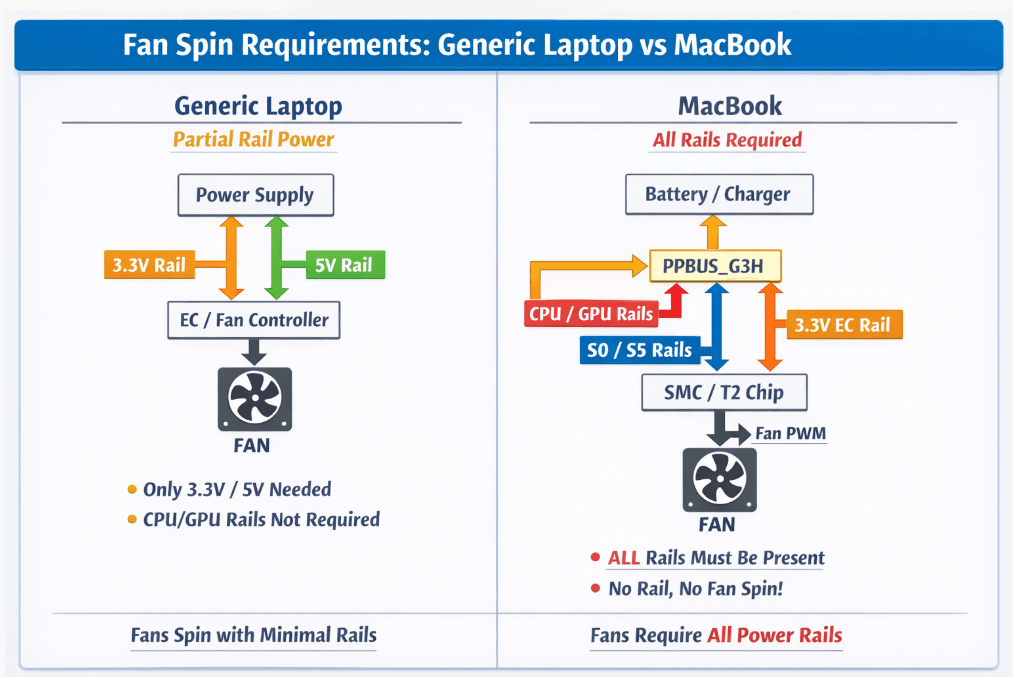
Laptop needs only two power rails present to obtain fan spin. MacBook requires all power rails to be be present to obtain fan spin. Is this true?

MacBook repair is always more challenging than non-MacBook repairs. That is one reason why we charge more for MacBook repairs.

EC = permissive, allows partial boot for testing
SMC = strict, enforces all required rails before any sign of life

This is why MacBooks seem “all-or-nothing” compared to PCs, even though technically some rails could be missing at certain states.

Practical repair insight

  • On a PC, you can:

    • Power up the board with a minimal number of rails

    • Test components individually

  • On a MacBook, you must:

    • Verify all required rails in the correct sequence

    • Check SMC handshakes & sense lines

    • Any missing rail → system refuses even basic activity

Security & logic differences

  • SMC checks battery, adapter, and voltage correctness before enabling high-power rails

  • EC in PCs often ignores battery status if adapter is present

  • MacBooks will refuse to “pretend to power on” — no partial boot allowed

  • EC allows testing “power presence” without full boot → why PC techs can hot-swap or probe live

Power sequencing

PC / EC:

  • EC enables 3–5 key rails

  • BIOS/UEFI can initialize CPU even if some optional rails are missing

  • EC monitors fans, battery, keyboard; missing optional rails → warning, but system may POST

Mac / SMC:

  • SMC enforces all required rails per power state

  • Uses voltage sense & current sense to verify rails before enabling next step

  • Missing a rail → SMC halts sequence → MacBook stays dead

  • Supports multiple voltage rails in strict order: PPBUS_G3H → 3.3V → 1.8V → CPU/GPU → RAM → S0 state

💡 Effectively, SMC is a “gatekeeper”; EC is more like a “traffic controller”.

Role in the system

FeatureEC (Embedded Controller, common in PCs)SMC (System Management Controller, Mac)
TypeMicrocontroller on motherboardCustom Apple microcontroller
Main jobHandles power button, keyboard, battery, fansHandles power sequencing, thermal, battery, fans, sleep/wake, SMC security
ScopeMostly peripheral + low-level powerFull system power state management + security + sensors
DependencePartial: laptop may “turn on” with EC poweredTotal: nothing happens until SMC enables all required rails

Summary: EC is permissive, SMC is strict.


1️⃣ General Laptops

  • Many typical laptops have fans connected directly to certain critical power rails, often 3.3 V or 5 V rails, and sometimes a PWM signal from the EC (embedded controller).

  • In practice, only a few rails need to be live for the EC to initialize enough to spin the fan.

  • Example: Some laptops will start the fan even if CPU/GPU rails are absent, because the EC just needs its 3.3 V and 5 V power rails.

✅ Key point: Fans can spin with partial rail power, because the fan circuitry is simpler and not tightly coupled to all power rails.


2️⃣ MacBooks (Air/Pro, T2/T1 or M1/M2 era)

  • Apple’s design is much stricter.

  • The PMIC (like ISL9240) and the System Management Controller (SMC) or T2 chip tightly control all power rails.

  • The fans are driven by the SMC/T2 and require:

    • PPBUS_G3H (main power rail)

    • S0/S3/S5 rails

    • CPU/GPU core rails

    • Some other supporting rails (like 3.3 V EC rail)

  • If any of these rails are missing, the SMC will not initialize fan control, so fans may stay off even if the EC or fan power lines are otherwise live.

❌ Key point: MacBooks typically require all main rails to be present before fans will spin.


✅ Summary Table

Laptop TypeNumber of Rails Needed for FanspinReason
Most generic laptops2–3 critical railsFans get basic EC or 3.3 V/5 V supply; EC allows fan spin even if CPU/GPU rails are absent
MacBooksAll main rails (PPBUS_G3H + CPU/GPU/MEM + S0/S5 etc.)SMC/T2 firmware checks all rails before enabling fan; fan PWM strictly controlled

So, what you said is essentially correct:

  • Generic laptops: fans may spin with only a few rails present.

  • MacBooks: fans usually won’t spin unless all power rails are live.


If you want, I can draw a simple block diagram showing which rails control fan spin for a MacBook vs a typical laptop — it makes this much easier to visualize.

Do you want me to do that?

yes

Perfect — let’s visualize it. I’ll make a simplified block diagram comparing generic laptops vs MacBooks and how power rails relate to fan spin.


1️⃣ Generic Laptop Fan Power Flow

 
[Power Supply] │ ├─ 3.3 V ──► EC / Fan Controller ──► FAN │ └─ 5 V ──► EC / Fan Controller ──► FAN
  • Only 3.3 V and 5 V rails are critical for fan to spin.

  • CPU/GPU rails may be absent → fan still spins.


2️⃣ MacBook Fan Power Flow (Air/Pro with SMC or T2)

 
[Battery / Charger] │ ▼ PPBUS_G3H ──┐ │ │ CPU/GPU Rails │ S0/S5 Rails │ 3.3 V EC Rail│ ▼ ▼ └─► SMC / T2 Chip ──► Fan PWM ──► FAN
  • All rails must be live for the SMC/T2 to initialize fan control.

  • If any rail missing, fan won’t spin, even if 3.3 V EC rail is present.


💡 Key Insight:

  • Generic laptops → “partial rail” fan spin

  • MacBooks → “full rail check” enforced by SMC/T2 firmware

Similar Posts

Leave a Reply

Your email address will not be published. Required fields are marked *